 by
by It is 2 p.m. on a Tuesday. You are at lunch, away from your desk, not thinking about work at all. Your phone buzzes. You pick it up and see a notification from your selling platform. Someone just bought one of your digital products while you were eating a sandwich.
You did not do anything. You did not ship anything. You did not speak to anyone. You did not even know the sale was happening. But money just landed in your account from a file you created once, weeks or months ago.
That is the reality of selling digital downloads. And in 2026, it will be more accessible, more profitable, and more beginner-friendly than ever.
This guide is going to show you exactly how to build that income stream — from your very first product idea all the way to your first sale and beyond. No technical degree required. No huge startup budget. Just a clear plan and the willingness to create something once and sell it forever.
What Are Digital Downloads?
Before we get into the how, let us make sure we are completely clear on the what.
A digital download is any product that exists in digital format and can be delivered to a customer instantly online without any physical shipping, packaging, or inventory. The customer pays, the file downloads automatically, and you never have to touch a thing.
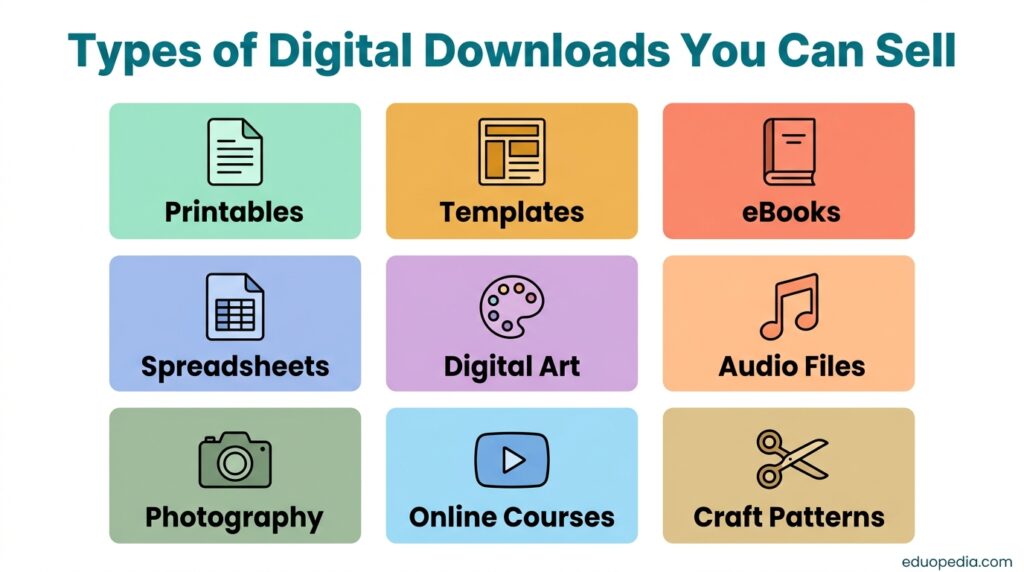
Digital downloads include:
- Printables — planners, trackers, journals, wall art, calendars, budget sheets
- Templates — Canva templates, resume templates, social media templates, email templates
- eBooks and guides — how-to guides, recipe books, travel guides, educational content
- Spreadsheets — budget spreadsheets, business trackers, content calendars, project planners
- Digital art — illustrations, clip art, patterns, backgrounds, fonts, graphics
- Music and audio — sound effects, beats, royalty-free music, meditation tracks
- Photography — stock photos, presets, Lightroom filters
- Courses and educational content — video lessons, workbooks, slide decks, study guides
- Business tools — contracts, proposals, invoice templates, standard operating procedures
- Craft patterns — sewing patterns, knitting patterns, crochet patterns, embroidery designs
The common thread across all of these is that you create the product once and sell it an unlimited number of times to an unlimited number of customers with zero additional effort or cost on your part after the initial creation.
That is the power of digital downloads. Your income scales without your time scaling with it.
Why 2026 Is the Best Time to Start
The digital download market has been growing steadily for years, but 2026 represents a genuinely special window of opportunity for new creators.
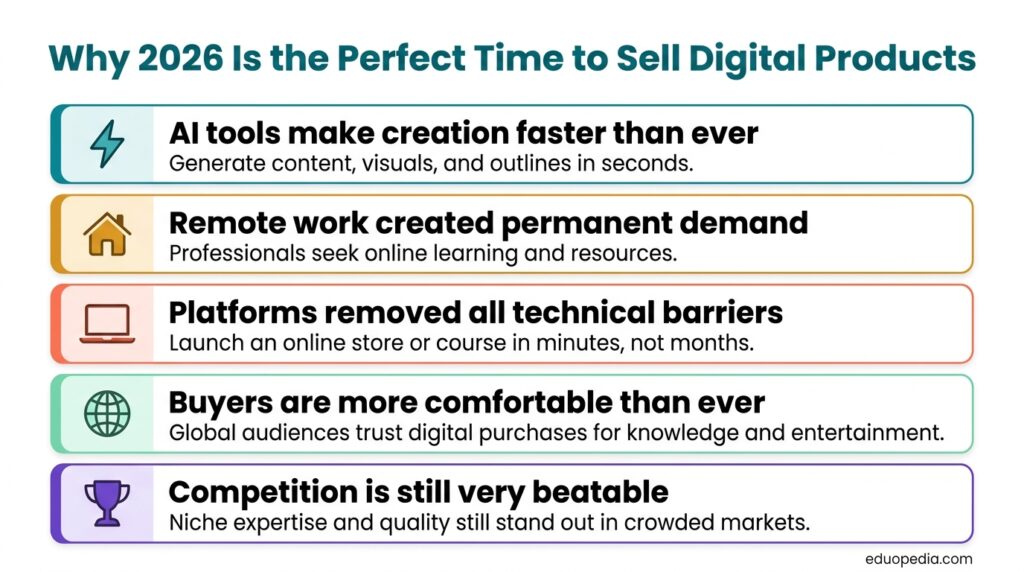
AI tools have made creation faster than ever. Tools like Canva, Adobe Express, ChatGPT, and dozens of specialised AI platforms mean that creating professional-quality digital products no longer requires years of design experience or a graphic design degree. Someone with a good idea and a few hours can now create a product that would have taken weeks and thousands of dollars just five years ago.
The remote work revolution created permanent demand. The shift to remote and hybrid work permanently changed how people work, organise, and manage their time. Demand for digital planners, productivity templates, business tools, and educational content has exploded — and it is not going back.
Platforms have eliminated all the technical barriers. In 2026, you do not need a website, a developer, or any technical knowledge to start selling digital products. Platforms like Etsy, Gumroad, Payhip, and Creative Market handle everything — payment processing, file delivery, customer service infrastructure, and built-in traffic.
Buyers are more comfortable than ever. A large share of the global population now regularly purchases digital products. The hesitation that early digital buyers felt about purchasing something they could not hold in their hands has almost entirely disappeared. Customers today know exactly what they are buying, and they trust the process completely.
The competition is still beatable. Despite the market’s rapid growth, the majority of digital product sellers are still making basic mistakes — poor product presentation, weak descriptions, no Pinterest or SEO strategy, and no product-line thinking. A new seller who comes in with a smart strategy can outperform sellers who have been on the platform for years.
Step 1 — Choose Your Digital Product Niche
The single most common mistake new digital product sellers make is creating a product first and then trying to find buyers. The far smarter approach is to find the buyers first and then create the product they are already looking for.
Here is how to choose a niche that will actually make money:
Start with what you already know. You do not need to be the world’s leading expert on something to create a valuable digital product about it. You need to know more than a beginner or be willing to research and organise information in a way that saves someone else time. A teacher can create classroom printables. A nurse can create health tracking spreadsheets. A stay-at-home parent can create family budget templates. A graphic designer can sell Canva templates. Your existing knowledge is your first unfair advantage.
Look for problems people are willing to pay to solve. The best digital products solve a specific, painful problem for a specific group of people. Search Etsy for products in your potential niche and look at what is selling. Check Pinterest for what content gets saved repeatedly. Look at Facebook groups and Reddit communities to see what questions people ask repeatedly. Every repeated question is a product waiting to be created.
Check the competition, but do not be scared of it. When you search a niche on Etsy and see thousands of results, your first instinct might be to think it is too crowded. Flip that thinking. Thousands of results mean thousands of customers actively searching and buying. A niche with no competition usually means no buyers. Competition is proof of demand.
Think about repeat buyers. Some niches naturally create repeat customers — someone who buys your January planner will likely want your February planner. Someone who buys your Instagram template pack may come back for your Pinterest template pack. Building a niche that keeps buyers coming back multiplies your income without requiring you to find new customers constantly.
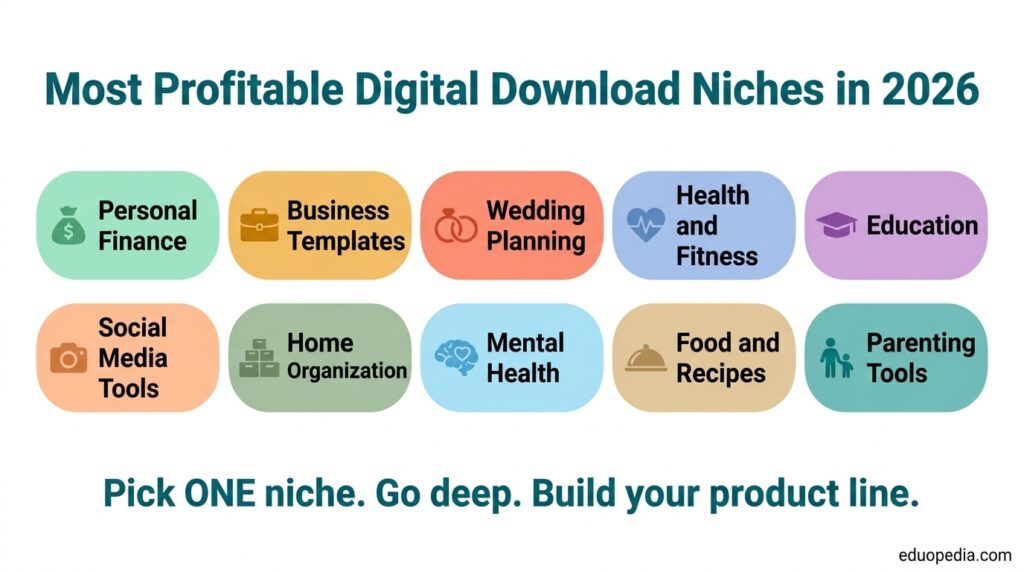
The most profitable digital download niches in 2026:
- Personal finance and budgeting tools
- Business and entrepreneur templates
- Wedding and event planning printables
- Health, wellness, and fitness trackers
- Education and homeschooling resources
- Social media and content creator tools
- Home organization and cleaning printables
- Mental health and self-care journals
- Food and recipe content
- Parenting and family management tools
Step 2 — Create Your First Digital Product
Now comes the part that stops most people before they even start. Creating the actual product. And here is the truth that nobody tells you — your first product does not need to be perfect. It needs to exist.
A mediocre product listed for sale will always outperform a perfect product sitting on your hard drive.
Here is how to create your first digital product without overthinking it:
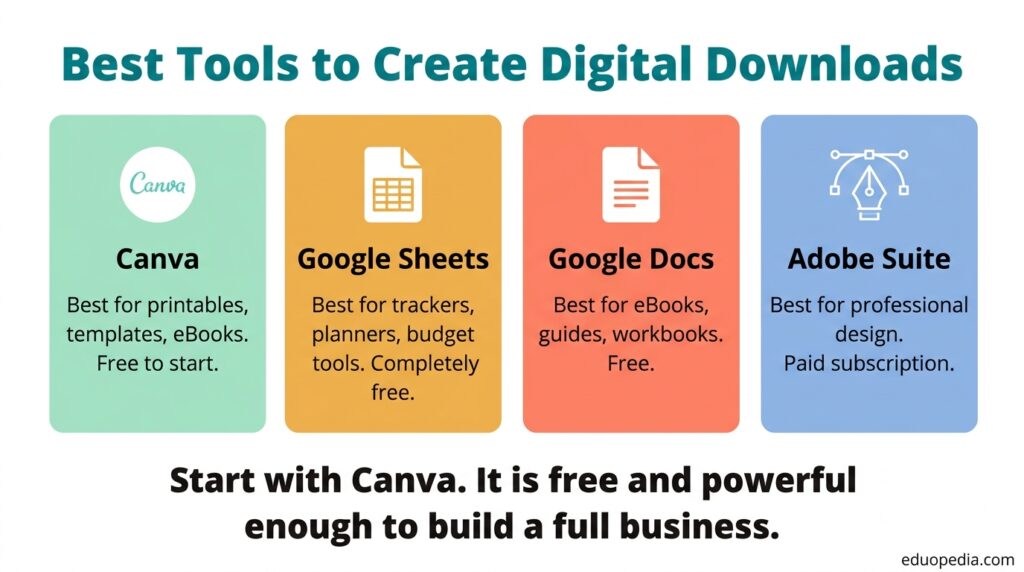
Choose your creation tool.
For most beginners to digital downloads, Canva is the answer. Canva is a free browser-based design tool with thousands of templates that can be customised into sellable digital products. You can create printable planners, wall art, social media templates, eBook covers, and almost anything else entirely within Canva’s free tier. The Pro version unlocks more features and is worth the investment once you start making sales.
For spreadsheets, Google Sheets or Microsoft Excel work perfectly. Budget trackers, habit trackers, business income trackers, and content calendars are all simple to create in a spreadsheet format.
For eBooks and guides, Canva, Google Docs, or Microsoft Word all work well, depending on how you want the final product designed.
For more advanced design work, Adobe Illustrator and Photoshop are industry standards but come with steeper learning curves and monthly subscription costs.
Keep your first product simple and specific.
Do not try to create a 50-page ultimate guide as your first product. Create something small, specific, and immediately useful. A one-page daily budget tracker. A one-week meal planning template. A set of five Instagram story templates in one colour scheme. A two-page wedding guest list spreadsheet.
Small, specific products are faster to create, easier to price, easier to describe to buyers, and often outsell larger, more complex products because their value is immediately obvious.
Think about your file format.
Most printable digital products are delivered as PDF files because PDFs look consistent across devices, cannot be easily edited by the buyer, and print cleanly. If you are creating a template the buyer needs to edit — like a Canva template or a spreadsheet — you will share a link to the template rather than a downloadable file. Always test your product on multiple devices before listing it.
Create multiple versions.
If you are creating a planner or printable, consider making it in two or three colour variations. Buyers love having options, and you can charge more for a bundle. If you make a budget tracker in teal, create it in blush pink and navy too. Three colour options that took you an extra 30 minutes to create could significantly increase your product’s perceived value.
Step 3 — Price Your Digital Products
Pricing is where most new sellers dramatically undervalue their work. Here is how to think about pricing correctly.
You are not selling a file. You are selling a result.
A customer buying your budget tracker is not paying for a PDF. They are paying for the time it would take them to build it themselves, the expertise it took you to design it effectively, and the outcome they will experience when they use it. Price accordingly.
Research your market.
Go to Etsy or whatever platform you plan to sell on and search for products similar to yours. Look at what the best-selling products are priced at — not the cheapest ones. The cheapest products are usually not the best-selling products. Buyers associate very low prices with low quality and often skip the $1 product in favour of the $8 product from a seller who presents their work professionally.
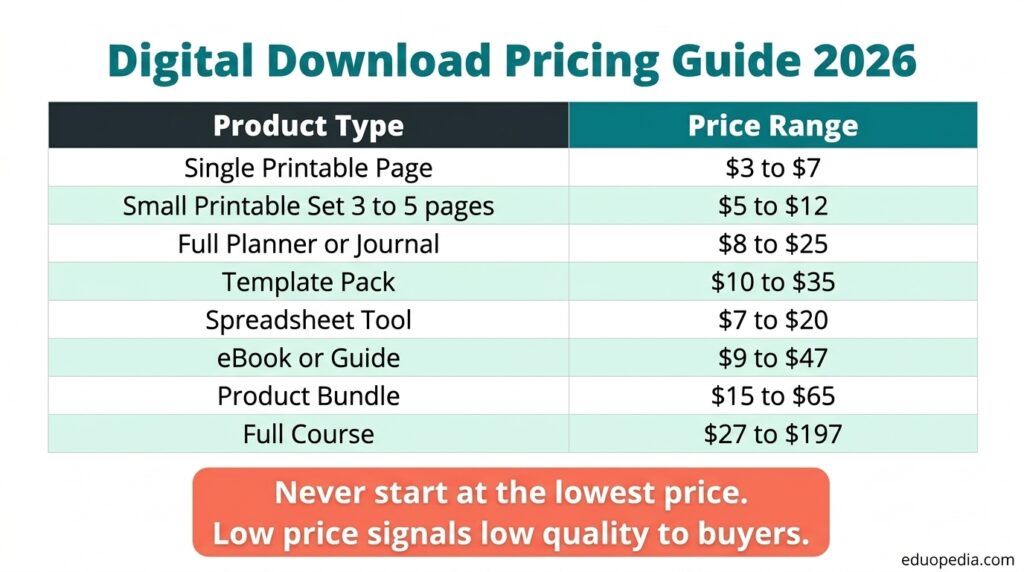
General pricing guidelines for 2026:
- Single printable page — $3 to $7
- Small printable set (3 to 5 pages) — $5 to $12
- Full planner or journal (20 plus pages) — $8 to $25
- Template pack (social media, Canva, etc.) — $10 to $35
- Spreadsheet tool — $7 to $20
- eBook or guide — $9 to $47
- Bundle of multiple products — $15 to $65
- Full course or comprehensive resource — $27 to $197
Do not start at the lowest price.
Starting at the lowest price in your niche signals to buyers that your product might be low quality. Start at a mid-range price, gather some reviews, and adjust from there based on what the market tells you.
Bundle products to increase your average sale value.
Once you have two or three products in the same niche, bundle them together at a slight discount. A buyer who was going to spend $8 on your budget tracker might happily spend $20 on your budget tracker, savings challenge tracker, and debt payoff planner bundled together. Bundles dramatically increase your revenue per customer.
Step 4 — Choose Where to Sell
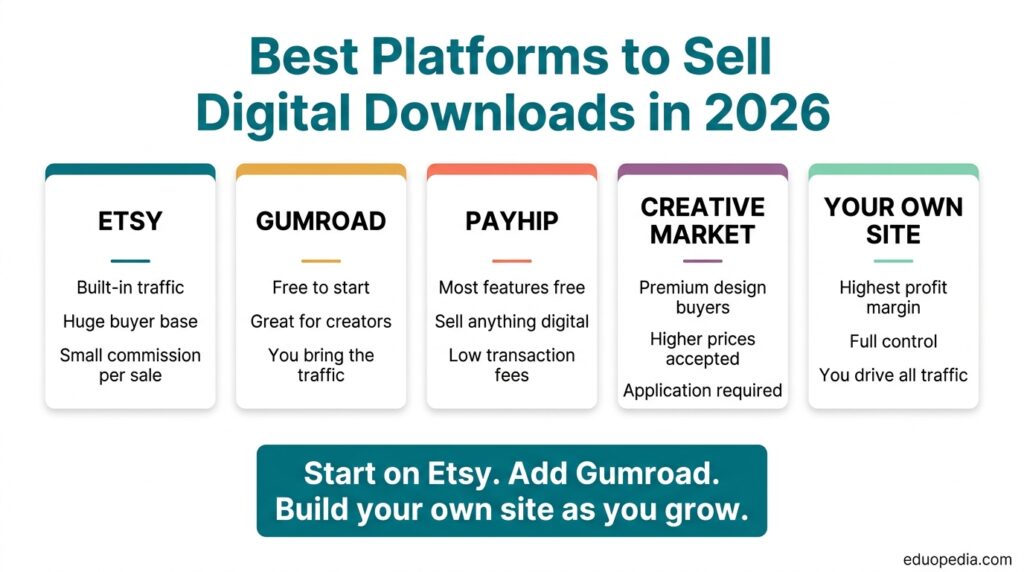
You have options for where to list your digital products, and the right choice depends on your goals, your niche, and how much control you want over your business.
Etsy
Etsy is the largest marketplace for handmade and creative digital products worldwide, and it remains the best starting point for most new digital download sellers in 2026. The platform has built-in traffic from millions of active buyers who are already searching for exactly the kinds of products most creators make. You pay a small listing fee per product and a commission on each sale, but the built-in audience makes it worth it for beginners. The main downside is that Etsy owns the customer relationship — you cannot email your buyers directly or build a list.
Gumroad
Gumroad is a clean, simple platform specifically designed for digital creators. It is completely free to start, automatically handles payment processing and file delivery, and gives you more control over your customer relationships than Etsy does. The downside is that Gumroad has no built-in marketplace traffic — you need to bring your own audience through Pinterest, social media, or your blog. This makes it ideal as a secondary platform once you have traffic, but not the best place to start if you have zero audience.
Payhip
Payhip is similar to Gumroad but with even more features on the free tier. You can sell digital downloads, memberships, courses, and physical products all in one place. Payhip takes a small percentage of each sale on the free plan, with the option to pay a monthly fee to reduce that percentage. Like Gumroad, it requires you to drive your own traffic.
Creative Market
Creative Market is a premium marketplace specifically for design assets — fonts, templates, graphics, themes, and design elements. If your digital products fall into the design category, Creative Market buyers are highly engaged and willing to pay premium prices. The application process for becoming a seller is more selective than Etsy’s, but the quality of buyers is exceptional.
Your Own Website
Selling digital products through your own website using a tool like WooCommerce, Shopify, or Podia gives you the most control, the highest profit margins, and full ownership of your customer relationships. The significant downside is that you are responsible for generating all of your own traffic. This is the best long-term goal for a serious digital product business, but not the right starting point for most beginners.
The smart strategy for 2026: Start on Etsy for traffic, add Gumroad or Payhip for your own audience, and build toward your own site as you grow.
Step 5 — Write Product Listings That Actually Sell
Your product listing is your salesperson. Most digital download sellers lose sales not because their products are bad but because their listings do not communicate value clearly enough to convert a browser into a buyer.
Here is how to write listings that sell:
Your title is your most important SEO tool.
On Etsy, your title is searchable. Every word in your title is a keyword that determines whether your product appears in search results. Do not write cute or clever titles — write descriptive keyword-rich titles that tell both the buyer and the search engine exactly what your product is.
Bad title: “Pretty Budget Planner” Good title: “Budget Planner Printable — Monthly Budget Tracker — Personal Finance Planner — Expense Tracker PDF — Instant Download”
Your first image is your storefront.
On any marketplace platform, your first product image is what stops a buyer scrolling or sends them past you. Invest real time in making your first image beautiful, clear, and professional. Show the product in use — a mockup of the printable laid out on a desk, a phone showing your template, a styled flat-lay showing what the buyer will receive. Free mockup generators like Placeit or Canva’s built-in mockups make this easy.
Your description should answer every question before it is asked.
Write your product description as if you are talking to a first-time buyer who does not yet fully understand digital downloads. Explain exactly what they will receive, what format the files are in, how they will access the download, whether they need any specific software to use it, and what they can and cannot do with it. Anticipate objections and answer them before the buyer has to ask.
Collect reviews aggressively.
Social proof is the single most powerful conversion tool on any marketplace platform. A product with 50 five-star reviews will dramatically outsell an identical product with zero reviews, even if the reviewed product is slightly worse. In the early days of your shop, focus relentlessly on getting those first 10 to 20 reviews. Consider reaching out to friends, family, or your social media audience to purchase and leave honest reviews. Once you have social proof, your conversion rate climbs automatically.
Step 6 — Drive Traffic With Pinterest
Here is the secret that separates digital download sellers who make $50 a month from those who make $5,000 a month — Pinterest.
Pinterest is not a social media platform. It is a visual search engine with over 450 million active users who use it specifically to find ideas, inspiration, and products to buy. The finance, productivity, wellness, and home organisation niches — the most popular digital download categories — perform exceptionally well on Pinterest.
Unlike Instagram, where your posts disappear within 24 hours, a Pinterest pin can drive traffic to your product listing for months or even years after you post it. This makes Pinterest the highest return-on-investment marketing channel available to digital product sellers.
How to use Pinterest to drive digital download sales:
Create a Pinterest business account linked to your product shop or blog. Design vertical pins at 1000x1500px that showcase your products beautifully. Create boards that match what your target buyers are searching for — “Budget Printables”, “Productivity Templates”, “Work From Home Tools”, “Personal Finance Resources”. Pin consistently — aim for at least five to ten new pins per week. Use keyword-rich pin titles and descriptions that match exactly what your buyers are searching for.
Sellers who combine a strong Etsy presence with a consistent Pinterest strategy report the highest sales volumes in the digital download space. Both channels feed each other — Etsy provides built-in marketplace traffic, and Pinterest provides long-term,m evergreen traffic that keeps sales coming in around the clock.
Step 7 — Build a Product Line, Not Just a Product
The biggest leap from making occasional sales to building a real income with digital downloads is thinking in product lines rather than individual products.
A single product can make you some money. A coordinated product line can build you a real business.
Here is what a product line looks like in practice. Imagine you start by selling a monthly budget tracker. That is your entry point: a tracker, a savings goal tracker, a printable no-spend challenge, a financial goals worksheet, a complete annual budget planner, and eventually a full personal finance bundle that includes everything. Each product in your line serves the same buyer at a different point in their journey. Every new product you add increases the chances that a buyer discovers you, increases the average amount they spend in your shop, and increases the likelihood they come back.
Successful digital product sellers think about their shop the way a book publisher thinks about an author — not as a single product but as an expanding universe of related products serving a dedicated audience.
Aim to have at least 10 to 20 products in your shop within your first six months. More products mean more search results you appear in, more opportunities for buyers to find you, and more revenue per customer.
How Much Can You Realistically Make?
Let us talk real numbers because the internet is full of people claiming they make $50,000 a month from digital downloads, and it is important to have honest expectations.
In your first month, Most new sellers make between $0 and $50. This is completely normal. You are building your foundation — your listings, your first reviews, your Pinterest presence. Do not judge your business by its first month.
By months three to six: With consistent effort — new products added regularly, Pinterest pins going out weekly, listing optimisation — most dedicated sellers start seeing $100 to $500 per month. This is real money for a side hustle that requires no inventory, no shipping, and no customer service calls.
By months 6 to 12: Sellers who have built a product line of 15 or more products, gathered a solid base of reviews, and maintained a consistent Pinterest strategy often reach $500 to $2,000 per month. At this point, the income starts to feel genuinely life-changing for many people.
Beyond year one: Sellers who treat this like a real business — continuing to add products, expanding to multiple platforms, building an email list, creating content that drives traffic — regularly report $2,000 to $10,000 per month. The top sellers in popular niches earn significantly more.
The key variable in all of these numbers is consistency. The sellers who make real money from digital downloads are not necessarily the most talented designers or the most experienced marketers. They are the ones who kept showing up — adding products, pinning consistently, improving their listings — long after the initial excitement faded.
The Tools You Need to Get Started
You do not need much to start. Here is your complete toolkit:
For creating products: Canva (free tier is sufficient to start), Google Sheets or Microsoft Excel for spreadsheets, Google Docs for written products
For selling: Etsy shop (free to open, small listing fees apply), Gumroad (free), Payhip (free tier available)
For marketing: Pinterest business account (free), Tailwind for Pinterest scheduling (optional but helpful), Canva for creating pin graphics
For mockups: Canva mockup features (free), Placeit (paid but affordable), Smartmockups (free tier available)
For tracking your business: A simple Google Sheets income tracker to monitor revenue, expenses, and best-selling products
Total startup cost to begin selling digital downloads: as low as $0 if you use free tiers across all platforms.
Common Mistakes to Avoid
Learning from other people’s mistakes is one of the fastest paths to success. Here are the most common errors new digital download sellers make:
Creating products nobody is searching for. Always validate demand before you spend time creating. Search your niche on Etsy and Pinterest before you build anything. If nobody is searching for it, nobody will buy it, no matter how good it is.
Listing one product and waiting. One product is not a shop. One product gives buyers almost no reason to browse, no opportunity to buy multiple items, and very little chance of appearing in search results across multiple search terms. List products consistently and keep your shop growing.
Using low-quality images. On digital marketplaces, your product images are everything. A great product with poor images will be completely ignored. A good product with stunning lifestyle mockup images will sell consistently. Never underestimate the power of beautiful product presentation.
Ignoring SEO completely. Both Etsy and Pinterest operate as search engines. If your titles, tags, and descriptions do not include the words buyers are actually searching for, your products will never be discovered, regardless of their quality. Spend real time on keyword research before you write a single listing.
Quitting too early. This is the number one mistake. Most successful digital product sellers will tell you they almost quit in months two, three, or four when sales were still slow. The income from digital downloads is not linear. It compounds. The work you do in month one continues to pay you in month twelve and beyond. Patience and persistence are the skills that separate the people who build this income stream from the people who tried it and walked away.
Not building an email list. An email list is the one asset in your business that nobody can take away. Etsy could change its algorithm tomorrow. Pinterest could reduce your reach. But your email list is yours forever. Start building it from day one, even if it grows slowly at first.
Your Action Plan — Start This Week
You now have everything you need to get started. Here is your step-by-step launch plan:
Day 1: Choose your niche. Search Etsy and Pinterest to validate demand. Write down your first five product ideas.
Days 2 and 3: Create your first product in Canva or Google Sheets. Keep it simple. Keep it specific. Get it done rather than getting it perfect.
Day 4: Open your Etsy shop if you do not already have one. Set up your shop name, banner, about section, and shop policies.
Day 5: Create your product mockup images using Canva or Placeit. Write your product listing with a keyword-rich title, full description, and all relevant tags.
Day 6: List your first product. Then immediately start creating your second product.
Day 7: Set up your Pinterest business account. Create your first three to five boards with keyword-rich names relevant to your niche. Create your first pin for your new product.
Week 2 and beyond: Add a new product every week. Pin five to ten times per week. Optimise listings that are getting views but not converting. Keep building.
Final Thoughts
Selling digital downloads is one of the few genuinely accessible income streams available in 2026 that requires minimal upfront investment, no inventory, no shipping, and no customer service phone calls at midnight. It rewards creativity, consistency, and strategic thinking more than it rewards money or connections.
But let us be completely honest about one thing. This is not a get-rich-quick scheme. It is a build-wealth-consistently opportunity. The people who treat it as a business — showing up, improving, expanding, and marketing consistently over months and years — are the ones who build the kind of income that changes their lives.
Your first product will probably not make you rich. Your tenth product might surprise you. Your fiftieth product will be working for you around the clock.
Start today. Create something once. Sell it forever.
📌 Found this helpful? Save this post to your Pinterest side hustle board and share it with someone who has been looking for a way to create income online. The right information at the right time can completely change someone’s financial future. eduopedia.com
Tags: how to sell digital downloads, digital products to sell online, make money with digital downloads, passive income ideas 2026, sell on Etsy, digital download business, make money online 2026, side hustle ideas, selling printables online, Etsy digital products