 by
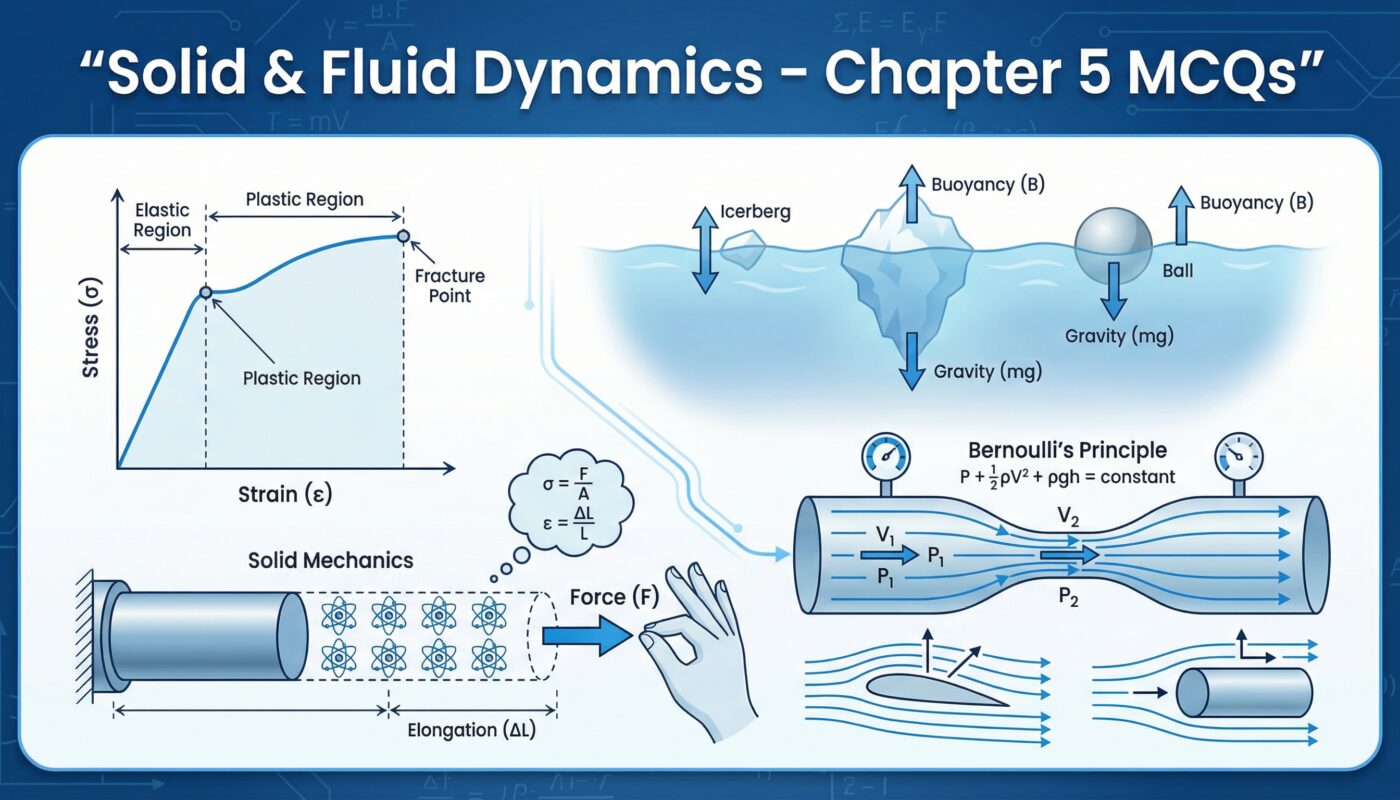
by 1. The region of the stress–strain curve which obeys Hooke’s law is:
A) Proportional limit
B) Elastic region
C) Plastic region
D) Yield limit
✅ Correct Answer: A) Proportional limit
Explanation:
Hooke’s law states that stress is directly proportional to strain. This proportionality is valid only up to the proportional limit, not throughout the entire elastic region.
2. Which of the following is more elastic?
A) Rubber
B) Wood
C) Sponge
D) Steel
✅ Correct Answer: D) Steel
Explanation:
Elasticity depends on Young’s modulus, not on how much a material stretches. Steel has a very high Young’s modulus, so it is more elastic than rubber or sponge.
3. Which of the following does not undergo plastic deformation?
A) Copper
B) Wrought iron
C) Lead
D) Glass
✅ Correct Answer: D) Glass
Explanation:
Glass is a brittle material. It breaks immediately after the elastic limit and shows no plastic deformation.
4. Substances which undergo plastic deformation until they break are known as:
A) Brittle substances
B) Ductile substances
C) Non-magnetic substances
D) Magnetic substances
✅ Correct Answer: B) Ductile substances
Explanation:
Ductile materials (such as copper and lead) can be drawn into wires and exhibit large plastic deformation before breaking.
5. Glass and high-carbon steel are examples of:
A) Ductile substances
B) Brittle substances
C) Soft substances
D) Hard substances
✅ Correct Answer: B) Brittle substances
Explanation:
Brittle materials break suddenly without significant plastic deformation. Both glass and high-carbon steel behave this way.
6. If stress is increased beyond the elastic limit, permanent change occurs. This behaviour is called:
A) Elasticity
B) Plasticity
C) Yield strength
D) Ultimate tensile strength
✅ Correct Answer: B) Plasticity
Explanation:
Plasticity is the property of a material to retain permanent deformation after the removal of stress.
7. Which pair of quantities has the same dimensions?
A) Stress and power
B) Pressure and bulk modulus
C) Stress and strain
D) Strain and strain energy
✅ Correct Answer: B) Pressure and bulk modulus
Explanation:
Both pressure and bulk modulus have dimensions of force per unit area (ML⁻¹T⁻²).
8. An example of a ductile substance is:
A) Glass
B) Wood
C) Lead
D) Oxygen
✅ Correct Answer: C) Lead
Explanation:
Lead is a ductile metal and can be stretched into thin wires.
9. SI unit of modulus of elasticity is:
A) Coulomb
B) Volt
C) Pascal (N m⁻²)
D) Ampere
✅ Correct Answer: C) Pascal (N m⁻²)
Explanation:
Modulus of elasticity is stress/strain, and stress is measured in Pascals.
10. Young’s modulus for water is:
A) Zero
B) 1
C) 2
D) 3
✅ Correct Answer: A) Zero
Explanation:
Liquids cannot resist tensile stress, so Young’s modulus for liquids is zero.
11. The SI unit of stress is the same as that of:
A) Pressure
B) Force
C) Momentum
D) Work
✅ Correct Answer: A) Pressure
Explanation:
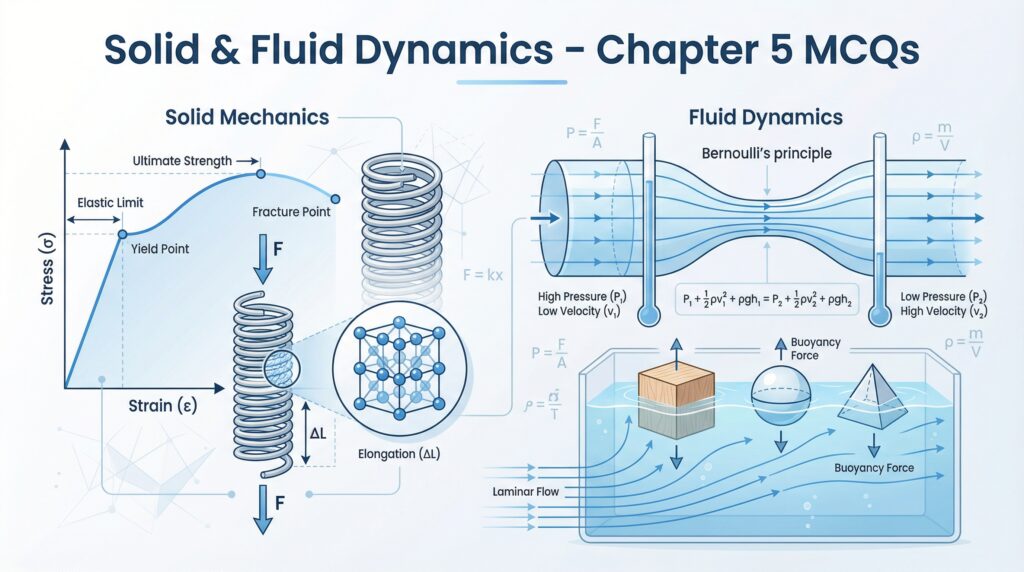
Stress = Force / Area, which is the definition of pressure.
12. The reciprocal of the bulk modulus is called:
A) Elasticity
B) Young’s modulus
C) Compressibility
D) Shear modulus
✅ Correct Answer: C) Compressibility
Explanation:
Compressibility is the rate at which a substance’s volume changes and is equal to 1/bulk modulus.
13. Substances which break just after the elastic limit is reached are called:
A) Ductile substances
B) Hard substances
C) Soft substances
D) Brittle substances
✅ Correct Answer: D) Brittle substances
Explanation:
Brittle materials break without entering the plastic region.
14. A wire is stretched by force F, producing extension ℓ. Energy stored is:
A) Fℓ
B) 2Fℓ
C) ½Fℓ
D) None of these
✅ Correct Answer: C) ½Fℓ
Explanation:
Strain energy stored in a stretched wire isU=21×Force×Extension
15. Dimensions of strain are:
A) L
B) L⁻¹
C) ML⁻¹T⁻²
D) Dimensionless
✅ Correct Answer: D) Dimensionless
Explanation:
Strain = Change in length / Original length → ratio, so it has no dimensions.
16. In a cubic crystal, all sides meet at:
A) Acute angles
B) Obtuse angles
C) Right angles
D) No fixed angles
✅ Correct Answer: C) Right angles
Explanation:
In a cubic crystal system, all angles are 90°.
17. The crystalline structure of NaCl is:
A) Tetragonal
B) Cubical
C) Hexagonal
D) Trigonal
✅ Correct Answer: B) Cubical
Explanation:
Common salt (NaCl) has a face-centred cubic structure.
18. Young’s modulus is the ratio of:
A) Strain to stress
B) Stress to strain
C) Force to displacement
D) Load to extension
✅ Correct Answer: B) Stress to strain
Explanation:Y=StrainStress
19. If the length of a wire becomes double, the strain is:
A) Halved
B) Doubled
C) Unchanged
D) Zero
✅ Correct Answer: B) Doubled
Explanation:
Strain = ΔL / L
If the length changes by a factor of 2, the strain also doubles.
20. A material with a high Young’s modulus is:
A) Easily stretched
B) Highly elastic
C) Soft and ductile
D) Very stiff and resists deformation
✅ Correct Answer: D) Very stiff and resists deformation
Explanation:
A high Young’s modulus means that large stress produces very small strain, so the material is stiff.
21. A material obeys Hooke’s law only within its:
A) Breaking point
B) Yield point
C) Elastic limit
D) Plastic region
✅ Correct Answer: C) Elastic limit
Explanation:
Hooke’s law is valid only while deformation is elastic. Beyond the elastic limit, stress is no longer proportional to strain.
22. Strain is defined as:
A) Change in length / Original length
B) Change in volume / Original volume
C) Force / Change in length
D) Original length / Change in length
✅ Correct Answer: A) Change in length / Original length
Explanation:
Strain measures relative deformation, not absolute change.
23. Strain energy is the energy:
A) Stored due to motion
B) Dissipated in vibration
C) Stored due to deformation
D) Lost as heat
✅ Correct Answer: C) Stored due to deformation
Explanation:
When a body is elastically deformed, work done is stored as strain energy.
24. Which material stores more strain energy before failure?
A) Brittle materials
B) Ductile materials
C) Rigid bodies
D) Fluids
✅ Correct Answer: B) Ductile materials
Explanation:
Ductile materials undergo large plastic deformation, allowing them to store more strain energy.
25. Strain energy in a deformed body is associated with:
A) Permanent deformation
B) Plastic deformation
C) Elastic deformation
D) Fracture energy
✅ Correct Answer: C) Elastic deformation
Explanation:
Strain energy is recoverable energy, so it exists only during elastic deformation.
26. Strain energy is recoverable in:
A) Elastic deformation
B) Plastic deformation
C) Creep
D) Fatigue
✅ Correct Answer: A) Elastic deformation
Explanation:
Only elastic deformation allows the body to return to its original shape, releasing stored energy.
27. When deformation exceeds the elastic limit, the material:
A) Returns to original shape
B) Undergoes plastic deformation
C) Becomes stronger
D) Melts
✅ Correct Answer: B) Undergoes plastic deformation
Explanation:
Beyond the elastic limit, the change becomes permanent.
28. Elastic deformation is:
A) Permanent change
B) Temporary change removed on unloading
C) Fracture
D) Phase change
✅ Correct Answer: B) Temporary change removed on unloading
Explanation:
Elastic deformation disappears when stress is removed.
29. Plastic deformation is:
A) Always reversible
B) Occurs before elastic deformation
C) Permanent change in shape
D) Only at low temperature
✅ Correct Answer: C) Permanent change in shape
Explanation:
Plastic deformation remains even after stress is removed.
30. Which material shows elastic behaviour only for small loads?
A) Rubber
B) Plastic
C) Mild steel
D) Glass
✅ Correct Answer: D) Glass
Explanation:
Glass is brittle and shows a very small elastic range.
31. The point where plastic deformation begins is called:
A) Breaking point
B) Proportional limit
C) Fracture point
D) Yield point
✅ Correct Answer: D) Yield point
Explanation:
At the yield point, the material starts permanent deformation.
32. Deformation occurring only within the elastic limit is:
A) Plastic
B) Ductile
C) Elastic
D) Brittle
✅ Correct Answer: C) Elastic
Explanation:
Elastic deformation occurs before the elastic limit.
33. Elastic limit is associated with which law?
A) Pascal’s law
B) Hooke’s law
C) Newton’s third law
D) Boyle’s law
✅ Correct Answer: B) Hooke’s law
Explanation:
Hooke’s law defines the elastic behaviour of materials.
34. The unit of elastic limit is the same as that of:
A) Strain
B) Stress
C) Force
D) Density
✅ Correct Answer: B) Stress
Explanation:
Elastic limit is the maximum stress value.
35. Beyond the elastic limit, the material enters:
A) Brittle zone
B) Proportional region
C) Plastic region
D) Elastic zone
✅ Correct Answer: C) Plastic region
Explanation:
In the plastic region, deformation becomes permanent.
36. Material with high elastic limit is:
A) Steel
B) Rubber
C) Glass
D) Copper
✅ Correct Answer: A) Steel
Explanation:
Steel can withstand large stress before permanent deformation.
37. The principle of flotation is based on:
A) Pascal’s law
B) Bernoulli’s law
C) Archimedes’ principle
D) Newton’s third law
✅ Correct Answer: C) Archimedes’ principle
Explanation:
Floating occurs when upthrust equals weight.
38. Buoyant force equals:
A) Weight of object
B) Volume of object
C) Weight of displaced fluid
D) Density of fluid
✅ Correct Answer: C) Weight of displaced fluid
Explanation:
This is the statement of Archimedes’ principle.
39. For a floating object, buoyant force is:
A) Less than weight
B) Equal to weight
C) Greater than weight
D) Zero
✅ Correct Answer: B) Equal to weight
Explanation:
A floating equilibrium occurs when the upthrust equals the weight.
40. Archimedes’ principle is used to determine:
A) Speed of fluid
B) Temperature of water
C) Refractive index
D) Relative density
✅ Correct Answer: D) Relative density
Explanation:
Archimedes’ principle helps measure the density and relative density of solids and liquids.
41. If a stone is immersed in water, its apparent weight:
A) Increases
B) Decreases
C) Becomes zero
D) Remains the same
✅ Correct Answer: B) Decreases
Explanation:
Water exerts an upward buoyant force (upthrust) on the stone, reducing its apparent weight.
42. A floating body displaces fluid equal to:
A) Its own weight
B) Its own volume
C) Twice its volume
D) Density of the fluid
✅ Correct Answer: A) Its own weight
Explanation:
According to the principle of flotation, a floating body displaces fluid equal to its weight.
43. The buoyant force acting on a body depends on:
A) Volume of the fluid
B) Density of the fluid
C) Acceleration due to gravity
D) All of these
✅ Correct Answer: D) All of these
Explanation:
Buoyant force = ρVg, so it depends on density, volume displaced, and gravity.
44. An object sinks in a fluid if its density is:
A) Less than the fluid
B) Equal to the fluid
C) Greater than the fluid
D) Independent of fluid
✅ Correct Answer: C) Greater than the fluid
Explanation:
If the object’s density is greater than the fluid’s density, the weight exceeds the upthrust, so it sinks.
45. The principle of flotation is based on:
A) Newton’s third law
B) Archimedes’ principle
C) Bernoulli’s principle
D) Pascal’s law
✅ Correct Answer: B) Archimedes’ principle
Explanation:
Flotation occurs due to the buoyant force, explained by Archimedes’ principle.
46. When a floating body is slightly pushed down and released, it will:
A) Sink
B) Oscillate about its mean position
C) Stay where pushed
D) Jump out of the water
✅ Correct Answer: B) Oscillate about its mean position
Explanation:
Restoring buoyant force causes the body to oscillate until equilibrium is reached.
47. The upthrust acting on a floating object is equal to:
A) Volume of object
B) Density of fluid
C) Weight of object
D) Volume of water displaced
✅ Correct Answer: C) Weight of object
Explanation:
For floating bodies, upthrust equals weight.
48. Which change does NOT affect floating or sinking?
A) Shape of object
B) Density of object
C) Density of fluid
D) Mass of fluid
✅ Correct Answer: D) Mass of fluid
Explanation:
Floating depends on density, not on the total mass of the fluid present.
49. A submarine floats or sinks by changing its:
A) Shape
B) Volume
C) Density
D) Water density
✅ Correct Answer: C) Density
Explanation:
By filling or emptying ballast tanks, a submarine changes its density.
50. Decrease in pressure with increase in fluid speed in a horizontal pipe is called:
A) Torricelli effect
B) Bernoulli effect
C) Venturi effect
D) Doppler effect
✅ Correct Answer: B) Bernoulli effect
Explanation:
According to Bernoulli’s principle, higher speed → lower pressure.
51. In steady streamline flow, friction:
A) Varies with velocity
B) Varies inversely with pressure
C) Is independent of pressure
D) First increases then decreases
✅ Correct Answer: A) Varies with velocity
Explanation:
Fluid friction increases as fluid velocity increases.
52. A steady flow means that:
A) Fluid is at rest
B) Velocity at a point does not change with time
C) Density remains constant
D) Fluid has no viscosity
✅ Correct Answer: B) Velocity at a point does not change with time
Explanation:
In steady flow, flow parameters remain constant at any point.
53. An ideal fluid is one that:
A) Has high viscosity
B) Is incompressible and non-viscous
C) Has uniform density only
D) Has zero surface tension
✅ Correct Answer: B) Is incompressible and non-viscous
Explanation:
Ideal fluids are theoretical fluids with no viscosity and constant density.
54. Which of the following is NOT a property of an ideal fluid?
A) Incompressibility
B) Zero viscosity
C) Constant temperature
D) Irrotational flow
✅ Correct Answer: C) Constant temperature
Explanation:
Temperature is not a defining property of an ideal fluid.
55. In a non-viscous fluid:
A) No internal friction exists
B) Density varies with pressure
C) Turbulent flow is common
D) Flow is unsteady
✅ Correct Answer: A) No internal friction exists
Explanation:
Non-viscous means zero internal resistance to flow.
56. Bernoulli’s equation applies to:
A) Viscous fluids
B) Compressible fluids
C) Fluids at rest
D) Steady, ideal, incompressible fluids
✅ Correct Answer: D) Steady, ideal, incompressible fluids
Explanation:
Bernoulli’s equation is valid only under ideal flow conditions.
57. In a steady flow of an ideal fluid:
A) No mechanical energy is lost
B) Flow is turbulent
C) Pascal’s law applies
D) Surface tension exists
✅ Correct Answer: A) No mechanical energy is lost
Explanation:
An ideal fluid has no viscosity, so energy is conserved.
58. In steady flow, streamlines:
A) Cross each other
B) Show direction of flow
C) Indicate random motion
D) Represent pressure gradient
✅ Correct Answer: B) Show direction of flow
Explanation:
Streamlines indicate the instantaneous direction of fluid motion.
59. A fluid with zero viscosity will:
A) Have no density
B) Not flow
C) Experience no drag or friction
D) Always be turbulent
✅ Correct Answer: C) Experience no drag or friction
Explanation:
Zero viscosity means no internal resistance.
60. The zero viscosity assumption is valid for:
A) Ideal fluids
B) Real gases
C) All liquids
D) High-pressure steam
✅ Correct Answer: A) Ideal fluids
Explanation:
Zero viscosity is an ideal assumption; it is not true for real fluids.
61. In a steady flow of an ideal fluid, the streamlines:
A) Intersect each other
B) Show random paths
C) Are parallel and do not cross
D) Form closed loops
✅ Correct Answer: C) Are parallel and do not cross
Explanation:
In steady flow, the velocity direction at any point is fixed. Therefore, streamlines never intersect; the fluid would have a single velocity at a single point.
62. In an ideal fluid, energy loss due to internal friction is:
A) Zero
B) Maximum
C) Constant
D) Variable
✅ Correct Answer: A) Zero
Explanation:
An ideal fluid has zero viscosity, so there is no energy loss due to friction.
63. A real fluid differs from an ideal fluid because a real fluid:
A) Has viscosity
B) Has no density
C) Is perfectly elastic
D) Is incompressible
✅ Correct Answer: A) Has viscosity
Explanation:
Real fluids always possess viscosity, while ideal fluids are assumed to have none.
64. If a stone weighs less in water than in air, this is due to:
A) Reduction of mass
B) Increase in density
C) Buoyant force acting upward
D) Gravitational force acting upward
✅ Correct Answer: C) Buoyant force acting upward
Explanation:
The upward buoyant force reduces the apparent weight of the stone in water.
65. The lift force on an aeroplane wing is mainly due to:
A) Viscosity of air
B) Density of air
C) Pressure difference above and below the wing
D) Gravitational force
✅ Correct Answer: C) Pressure difference above and below the wing
Explanation:
According to Bernoulli’s principle, faster air over the wing creates lower pressure, producing lift.
66. A Venturi mask used in medicine works on the principle of:
A) Newton’s law
B) Archimedes’ principle
C) Pascal’s law
D) Bernoulli’s principle
✅ Correct Answer: D) Bernoulli’s principle
Explanation:
Venturi masks use pressure drop at high speed to mix air with oxygen.
67. The equation of continuity is based on conservation of:
A) Energy
B) Momentum
C) Mass
D) Volume
✅ Correct Answer: C) Mass
Explanation:
The continuity equation states that the mass flow rate remains constant in steady flow.
68. If the cross-sectional area of a pipe decreases, the speed of fluid:
A) Increases
B) Decreases
C) Remains constant
D) Becomes zero
✅ Correct Answer: A) Increases
Explanation:
From continuity equation:Av=constant
So when the area decreases, the velocity increases.
69. In a pipe, if the area becomes twice, the velocity becomes:
A) Half
B) Double
C) Four times
D) Same
✅ Correct Answer: A) Half
Explanation:
Velocity is inversely proportional to area in steady flow.
70. Which quantity remains constant in the continuity equation for incompressible fluid?
A) Pressure
B) Velocity
C) Density
D) Volume flow rate
✅ Correct Answer: D) Volume flow rate
Explanation:
For incompressible fluids, volume flow rate (Av) remains constant.
71. The equation of continuity applies best to:
A) Turbulent flow
B) Unsteady flow
C) Steady incompressible flow
D) All types of flow
✅ Correct Answer: C) Steady incompressible flow
Explanation:
The continuity equation assumes steady flow and constant density.
72. The quantity that remains constant according to the continuity equation is:
A) Volume
B) Mass flow rate
C) Pressure
D) Area
✅ Correct Answer: B) Mass flow rate
Explanation:
Mass flow rate = ρAv, which remains constant.
73. Torricelli’s theorem is derived from:
A) Law of conservation of momentum
B) Law of conservation of energy
C) Bernoulli’s equation
D) Pascal’s law
✅ Correct Answer: C) Bernoulli’s equation
Explanation:
Torricelli’s theorem is a direct application of Bernoulli’s principle.
74. Torricelli’s theorem is used to find:
A) Pressure at the surface
B) Velocity of fluid leaving an orifice
C) Volume of tank
D) Viscosity of fluid
✅ Correct Answer: B) Velocity of fluid leaving an orifice
Explanation:
It gives the speed of efflux of liquid from a tank.
75. The velocity of fluid flowing out of a tank depends on:
A) Viscosity of fluid
B) Shape of container
C) Height of liquid above the opening
D) Temperature of fluid
✅ Correct Answer: C) Height of liquid above the opening
Explanation:
According to Torricelli’s theorem:v=2gh
76. In Torricelli’s theorem, fluid at the surface is assumed to be:
A) At rest
B) Under pressure
C) Flowing at high speed
D) Compressible
✅ Correct Answer: A) At rest
Explanation:
The surface area is large, so the velocity is negligible.
77. Pressure is low where fluid speed is:
A) Zero
B) High
C) Low
D) Medium
✅ Correct Answer: B) High
Explanation:
Bernoulli’s principle states that higher speed corresponds to lower pressure.
78. The law of conservation of energy is the basis of:
A) Streamline flow
B) Continuity equation
C) Bernoulli’s equation
D) Venturi relation
✅ Correct Answer: C) Bernoulli’s equation
Explanation:
Bernoulli’s equation is derived from the conservation of energy.
79. The law of conservation of mass is the basis of:
A) Bernoulli’s equation
B) Continuity equation
C) Stokes’ law
D) Viscosity
✅ Correct Answer: B) Continuity equation
Explanation:
The continuity equation ensures that mass in = mass out.
80. Bernoulli’s theorem applies to:
A) Solids
B) Plasma
C) Fluids
D) Gases only
✅ Correct Answer: C) Fluids
Explanation:
Bernoulli’s theorem applies to flowing fluids under ideal conditions.
81. When the streamlines of a fluid come closer together, the:
A) Speed of the fluid decreases
B) Speed of the fluid increases
C) Pressure of the fluid increases
D) Speed remains constant
✅ Correct Answer: B) Speed of the fluid increases
Explanation:
Closer streamlines indicate a higher fluid particle velocity.
82. A Venturi meter is a device used to measure:
A) Density of fluid
B) Speed of fluid
C) Pressure of fluid
D) Viscosity of fluid
✅ Correct Answer: B) Speed of fluid
Explanation: A
Venturi meter uses pressure difference to calculate fluid velocity.
83. The working principle of a carburettor in a car is based on:
A) Equation of continuity
B) Gravitational law
C) Bernoulli’s theorem
D) Stokes’ law
✅ Correct Answer: C) Bernoulli’s theorem
Explanation:
A carburettor mixes air and fuel by using the pressure drop caused by high speed.
84. A horizontal pipe narrows from 10 cm in diameter to 5 cm in diameter. Then:
A) Velocity and pressure both increase
B) Velocity increases and pressure decreases
C) Velocity decreases and pressure increases
D) Both velocity and pressure decrease
✅ Correct Answer: B) Velocity increases and pressure decreases
Explanation:
Smaller area → higher speed → lower pressure (Bernoulli’s principle).
85. The swing of a cricket ball is produced to:
A) Increase the speed of the ball
B) Decrease the speed of the ball
C) Deceive the batsman
D) Apply force on the ball
✅ Correct Answer: C) Deceive the batsman
Explanation:
Swing causes unexpected deviation, making it difficult to judge direction.
86. When water falls from a tap, its cross-sectional area decreases due to:
A) Decrease in speed
B) Increase in speed
C) Air pressure
D) Increase in gravity
✅ Correct Answer: B) Increase in speed
Explanation:
As water falls, speed increases due to gravity. From continuity, the area decreases.
87. A chimney works best when it is:
A) Tall
B) Wide
C) Short
D) Narrow
✅ Correct Answer: A) Tall
Explanation:
A taller chimney creates a greater pressure difference, improving airflow.
88. A fluid is said to be incompressible if its density is:
A) Zero
B) Very high
C) Very small
D) Constant
✅ Correct Answer: D) Constant
Explanation:
In incompressible fluids, density does not change with pressure.
89. The equation of continuity gives conservation of:
A) Mass
B) Energy
C) Speed
D) Volume
✅ Correct Answer: A) Mass
Explanation:
The continuity equation ensures the mass flow rate remains constant.
90. The product of the area of cross-section, velocity and time gives:
A) Volume
B) Density
C) Mass
D) Weight
✅ Correct Answer: A) Volume
Explanation:Volume=A×v×t
91. The speed of efflux equal to the velocity gained by falling through a height is called:
A) Torricelli’s theorem
B) Bernoulli’s theorem
C) Stokes’ theorem
D) Venturi theorem
✅ Correct Answer: A) Torricelli’s theorem
Explanation:
It states that efflux speed equals the speed gained by falling through height h.
92. Formula One racing cars have:
A) Streamlined design
B) Turbulent design
C) Rectangular design
D) Elliptical design
✅ Correct Answer: A) Streamlined design
Explanation:
Streamlining reduces air drag, allowing higher speed.
93. Laminar flow occurs at:
A) High speed
B) Low speed
C) Zero speed
D) Very high speed
✅ Correct Answer: B) Low speed
Explanation:
Laminar flow exists when fluid moves smoothly in layers.
94. Bernoulli’s equation applies to a fluid which is:
A) Viscous
B) Compressible
C) In turbulent flow
D) In steady flow
✅ Correct Answer: D) In steady flow
Explanation:
Bernoulli’s equation requires steady, ideal flow.
95. Pressure is high where fluid speed is:
A) High
B) Low
C) Constant
D) Zero
✅ Correct Answer: B) Low
Explanation:
According to Bernoulli’s principle, low speed → high pressure.
96. The maximum drag force on a 1 kg falling body is:
A) 9.8 N
B) 1 N
C) 98 N
D) 4.9 N
✅ Correct Answer: A) 9.8 N
Explanation:
At terminal velocity, drag force equals weight (mg = 9.8 N).
97. The product of cross-sectional area and fluid speed in a pipe is:
A) Zero
B) Variable
C) Constant
D) Infinite
✅ Correct Answer: C) Constant
Explanation:
From continuity equation:Av=constant
98. The continuity equation is the statement of conservation of:
A) Energy
B) Momentum
C) Mass
D) Charge
✅ Correct Answer: C) Mass
Explanation:
It ensures the mass flow rate remains unchanged.
99. For an incompressible fluid, which quantity remains constant?
A) Mass
B) Density
C) Pressure
D) Force
✅ Correct Answer: B) Density
Explanation:
In incompressible fluids, density does not change.
100. The product of the area and the velocity of fluid at any point in a pipe:
A) Remains constant
B) Becomes zero
C) Increases exponentially
D) Decreases exponentially
✅ Correct Answer: A) Remains constant
Explanation:
This follows directly from the continuity equation.
101. Decrease in cross-sectional area of water falling from a tap is explained by:
A) Bernoulli’s equation
B) Continuity equation
C) Venturi relation
D) None of these
✅ Correct Answer: B) Continuity equation
Explanation:
As speed increases due to gravity, the area decreases to conserve the flow rate.