by
by The Benazir Income Support Programme (BISP) has begun releasing its latest quarterly payment under the 8171 system, bringing much-needed financial relief to low-income households across Pakistan. Starting from 15 July 2026, eligible women beneficiaries will begin receiving Rs. 13,500 as part of the program’s ongoing effort to support families struggling with the rising cost of living.
For millions of families who depend on this support, understanding the payment timeline, eligibility rules, and verification process is essential to avoid delays or missed installments. This article breaks down the key details of the July 2026 disbursement cycle, including how the rollout works, who qualifies, how to register if you haven’t already, and how to check your payment status.
Understanding the July 2026 Disbursement
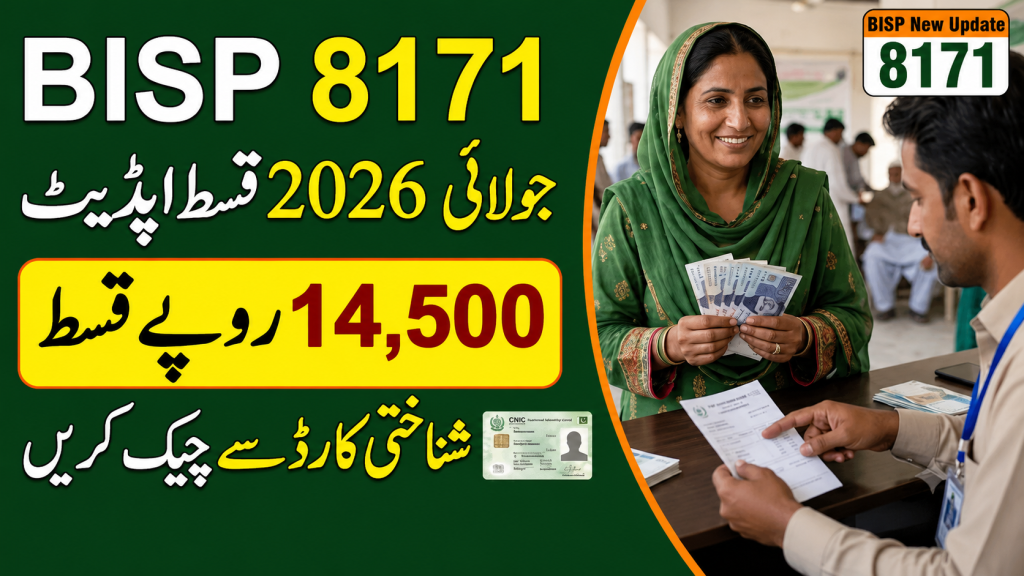
BISP payments are issued on a quarterly basis, meaning every three months the government transfers a fixed cash amount to registered women who meet the program’s poverty criteria. For the current cycle, that amount stands at Rs. 13,500 — a figure the government has adjusted over time to help offset inflation and keep pace with the rising cost of basic household needs.
Because BISP serves such a large population spread across every province, the disbursement isn’t released all at once. Instead, it rolls out in phases, with different districts and beneficiary groups receiving access to their funds on different dates. This phased approach is meant to prevent overcrowding at payment points and ensure smoother processing overall, but it also means that two people with similar circumstances in different regions might see their payment become available on different days.
A key factor in determining who falls into the earlier phases is the status of a beneficiary’s record in the National Socio-Economic Registry (NSER). Individuals whose NSER Dynamic Survey has already been finalized, and whose CNIC remains active and unblocked, tend to be processed first. Anyone still waiting on survey verification or CNIC renewal should expect to be included in a later phase once those issues are resolved.
Where Beneficiaries Can Collect Their Payment
Once a payment becomes available, recipients have several options for collecting their funds, which gives people in different areas — urban and rural alike — a convenient way to access their money without needing a traditional bank account. These channels typically include:
- Designated government-run payment camps set up specifically for BISP disbursements
- HBL Konnect agent locations, which allow cash withdrawal using biometric verification
- Bank Alfalah payment centers, another biometric-based cash collection option
- Authorized JazzCash retail agents, offering a mobile-money alternative to in-person bank visits
Beneficiaries are strongly encouraged to confirm that their payment has actually been activated before traveling to any of these centers. Showing up without confirming status first can mean wasted time and transport costs if the payment hasn’t yet been released for that particular phase or region.
Who Qualifies for the BISP 8171 Payment
Eligibility for BISP is determined primarily through a poverty scoring mechanism known as the Proxy Means Test (PMT). Households are scored based on a range of socioeconomic indicators collected during the NSER survey, and only those falling under a specific poverty threshold are approved for support.
The core eligibility requirements include:
- PMT score below 32 — this threshold is used to identify households considered to be living below the poverty line.
- Female head of household — BISP is specifically designed to channel support directly to women, recognizing their central role in managing household spending.
- Valid, active CNIC — an expired or blocked computerized national identity card will prevent a household from receiving payment, even if otherwise eligible.
- Completed NSER Dynamic Survey — this survey is the backbone of the eligibility determination and must be up to date.
- No large or disqualifying assets — households with significant property, vehicles, or other high-value assets are typically excluded.
- Not employed by the government — individuals in government service, or households where a family member holds such a position, are generally ineligible.
- No extensive record of overseas travel — frequent or high-value international travel history can be a red flag during the verification process and may lead to disqualification.
Meeting all of these conditions doesn’t guarantee automatic approval, but it substantially improves the chances of a smooth, delay-free disbursement.
How to Register if You’re Not Yet Enrolled
Unlike some government services that have moved entirely online, BISP registration for new applicants still requires an in-person visit. There is currently no way to register for the program purely through a website or mobile app — the process runs through the NSER Dynamic Survey, which must be completed at a BISP Tehsil Office.
Here’s what the registration process generally looks like:
Step 1: Visit your nearest BISP Tehsil Office. Applicants need to go in person, collect a token number, and wait for their turn to be called.
Step 2: Complete the Dynamic Survey. A BISP representative will record detailed information about the household, including the number of family members, monthly income, children’s school enrollment status, any assets owned, and details about the family’s residence.
Step 3: Keep your survey slip safe. After the survey is finished, applicants receive a receipt or slip confirming that the survey was completed. This document is important for tracking the application later and should not be lost.
Step 4: Wait for verification. Processing an application can take several weeks, as BISP cross-checks the submitted information against other government databases. Once the verification process concludes, applicants can check their approval status using any of the methods described below.
How to Check Your BISP 8171 Payment Status
There are multiple ways for both new and existing beneficiaries to check whether they are eligible and whether a payment is currently available to them:
Online via the 8171 Web Portal. Applicants can visit the official BISP web portal, enter their CNIC number, complete a simple captcha verification, and submit the request to see their current status.
Via SMS. Sending a 13-digit CNIC number as a text message to the short code 8171 typically generates an automatic reply within minutes, indicating whether the sender is eligible and what their payment status is.
By calling the helpline. The BISP helpline, 0800-26477, connects beneficiaries with official representatives who can answer questions about registration, payment delays, or eligibility disputes.
By visiting a Tehsil Office in person. For beneficiaries who prefer face-to-face support or who are dealing with a more complicated case, visiting the local BISP office remains an option.
When checking status through any of these channels, beneficiaries will typically see one of three outcomes: Eligible, Under Verification, or Not Eligible. An “Under Verification” result simply means the application is still being processed and doesn’t necessarily indicate a problem — though it’s worth following up if the status doesn’t change after several weeks.
The Bigger Picture: Kafalat and Additional Support
The Rs. 13,500 quarterly payment is issued under the Benazir Kafalat Program, the unconditional cash transfer component of the broader BISP initiative. At this rate, an eligible household can receive as much as Rs. 54,000 over the course of a year through Kafalat alone.
Families with children enrolled in school may also be able to access additional support through Benazir Taleemi Wazaif, a separate education stipend that rewards consistent school attendance. This program is designed to work alongside Kafalat, giving households an added incentive to keep children — particularly girls — enrolled in school rather than pulling them out of education for financial reasons.
Common Reasons Payments Get Delayed
Even fully eligible beneficiaries sometimes experience delays in receiving their quarterly payment. Some of the most frequent causes include:
- Inactive or blocked CNICs, which prevent biometric verification at payment points
- Incomplete or outdated NSER survey data, requiring re-verification before funds can be released
- Being placed in a later disbursement phase, simply due to geographic rollout scheduling
- Discrepancies found during cross-checks, such as mismatched income or asset information
- Technical or banking issues at the payment collection point itself
Anyone experiencing an unexplained delay is encouraged to check their status through the SMS service or web portal first, and to contact the helpline or visit a Tehsil Office if the issue isn’t resolved after checking.
Final Thoughts
The July 2026 BISP 8171 payment cycle represents another step in the government’s ongoing effort to provide direct financial relief to Pakistan’s most vulnerable households. While the phased rollout means not everyone will receive their funds on the same date, beneficiaries who keep their CNIC active, ensure their NSER survey information is current, and regularly check their status through the 8171 SMS service or web portal are the most likely to receive their payment without unnecessary delay.